

Media
630 CHED, March 11, 2014Radio/Podcast
An interview in which I discuss the results of one of my studies, which found that products targeted towards helping babies to read weren't successful. My segment starts at 21 minutes into the provided link
Educational’ products don’t make babies smarter: Canadian study
Global News, March 10, 2014Print
URL: http://globalnews.ca/news/1197963/educational-products-dont-make-babies-smarter-canadian-study/
Global News reports on the findings from one of my studies, which found that educational products targeted towards helping babies to read weren't successful.
Can Knowledge Level The Learning Field For Children?
Albert Shanker Institute, November 20, 2013Online
URL: http://www.shankerinstitute.org/blog/can-knowledge-level-learning-field-children
The Shanker Blog discusses the results of one of my studies which found that differences in background knowledge may explain some socio-economic differences in children's word-learning and reading comprehension.
This is not available 018257
by Tanya Kaefer
ProQuest, UMI Dissertation Publishing
1243632348
This book is not available.
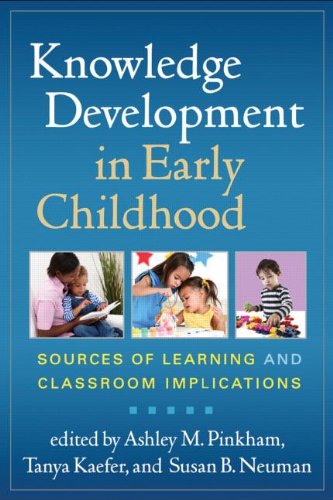
Knowledge Development in Early Childhood: Sources of Learning and Classroom Implications
The Guilford Press
146250499X
Synthesizing cutting-edge research from multiple disciplines, this book explores how young children acquire knowledge in the "real world" and describes practical applications for early childhood classrooms. The breadth and depth of a child's knowledge base are important predictors of later literacy development and academic achievement. Leading scholars describe the processes by which preschoolers and primary-grade students acquire knowledge through firsthand experiences, play, interactions with parents and teachers, storybooks, and a range of media. Chapters on exemplary instructional strategies vividly show what teachers can do to build children's content knowledge while also promoting core literacy skills.
Seeing and Knowing: Attention to Illustrations during Storybook Reading and Narrative Comprehension in 2-year-olds
Published by Infant and Child Development
December 19, 2016
Research (Evans & Saint-Aubin, 2005) suggests systematic patterns in how young children visually attend to storybooks. However, these studies have not addressed whether visual attention is predictive of children’s storybook comprehension. In the current study, we used eye-tracking methodology to examine two-year-olds’ visual attention while being read an unfamiliar storybook. Immediately following reading, they completed a comprehension assessment. Children who visually attended to illustrations depicting key narrative events during the initial reading demonstrated stronger comprehension than children who focused on other areas. Importantly, visual attention to pertinent illustrations was also positively related to parental reports of vocabulary knowledge. Collectively, this supports a reciprocal model of early knowledge development: vocabulary knowledge facilitates visual attention, and visual attention to storybook illustrations facilitates subsequent learning.
URL: http://onlinelibrary.wiley.com/doi/10.1002/icd.2018/full
Preexisting background knowledge influences socioeconomic differences in preschoolers’ word learning and comprehension.
Published by Reading Psychology
February 1, 2015
(With SB Neuman & AM Pinkham) The goal of the current study was to explore the influence of knowledge on socioeconomic discrepancies in word learning and comprehension. After establishing socioeconomic differences in background knowledge (Study 1), the authors presented children with a storybook that incorporates this knowledge (Study 2). Results indicated that middle-income children learned significantly more words and comprehended the story better than lower-income children. By contrast, Study 3 presented children with a novel category and found that children performed equally in their word learning and comprehension. This suggests that socioeconomic differences in vocabulary and comprehension skills may be partially explained by differences in extant knowledge.
URL: http://www.tandfonline.com/doi/full/10.1080/02702711.2013.843064
Integrating phonological and orthographic knowledge in early readers: Implicit and explicit knowledge
Published by Child Development Research
August 9, 2016
Children develop some orthographic knowledge before learning to read. In some contexts phonological knowledge can scaffold orthographic understanding, but in others, phonological knowledge must be ignored in favor of orthographic knowledge. The current study examines the development of orthographic knowledge as it interacts with phonological knowledge in early readers. Forty-five Kindergarten students were presented with two different nonwords on screen and their gaze was tracked. In the first task, they were asked to choose the best “word,” and in the second task they were asked to choose the best “word” for a specific pronunciation, thereby requiring phonological decoding of the stimuli. Our findings indicate that early readers show explicit awareness of some orthographic conventions and implicit awareness of others, but they only showed implicit awareness when they did not have to additionally decode the stimuli. These results suggest that early orthographic knowledge may be fragile and easily masked by phonological knowledge.
Can babies learn to read? A randomized trial of baby media
Published by Journal of Educational Psychology
August 1, 2014
(With, SB Neuman, AM Pinkham, and GA Stause) Targeted to children as young as 3 months old, there is a growing number of baby media products that claim to teach babies to read. This randomized controlled trial was designed to examine this claim by investigating the effects of a best-selling baby media product on reading development. One hundred and seventeen infants, ages 9 to 18 months, were randomly assigned to treatment and control groups. Children in the treatment condition received the baby media product, which included DVDs, word and picture flashcards, and word books to be used daily over a 7-month period; children in the control condition, business as usual. Examining a 4-phase developmental model of reading, we examined both precursor skills (such as letter name, letter sound knowledge, print awareness, and decoding) and conventional reading (vocabulary and comprehension) using a series of eye-tracking tasks and standardized measures. Results indicated that babies did not learn to read using baby media, despite some parents displaying great confidence in the program’s effectiveness.
Biography
Tanya Kaefer is an assistant professor in the Faculty of Education at Lakehead University in the field of Educational Psychology. She studies the development of children’s knowledge and the cognitive processes involved in early learning. Specifically, she examines the sources of children’s knowledge - experiences, people, books and media - and how this knowledge may influence future learning and development. Kaefer teaches courses in Educational Psychology and Inclusive Education.
Past Talks
The role of background knowledge in children’s word learning in shared book reading: An eye movement study.
Society for Research in Child Development Biennial Meeting
Philadelphia, PA, March 19, 2015
Seeing and knowing: Attention to illustrations during storybook reading and narrative comprehension in 2-year-olds
Cognitive Development Society Annual Meeting
Columbus, OH, October 10, 2015
How educational is educational television? Transferrable content and linguistic markers in children’s educational television
American Educational Research Association Annual Meeting
Philadelphia, PA, April 5, 2014
Experience with video influences infants’ attention to informative content: And eye-movement study.
Society for Research in Child Development Biennial Meeting,
Seattle, WA, April 19, 2013