


Media
Why Positive Thinking is Not Enough
Is positive thinking mandatory for success? Success is often cloaked under the banner of positive thinking. My talk proposes that the secret to success lay in self-questioning. While positive thinking makes you feel good and appears to be motivating if (and when) we become aware of our negative thoughts, and start asking self-questions, negative thinking can create a pathway toward success. Positive thinking, I argue, is an affirmation of the “feel good” culture we live in. Catchphrases that describe positive thinking – “keep your head up,” “keep it positive,” “have a positive mental attitude” do not speak to a plan of action to tackle one’s problems but instead remain at the level emotional affirmation. My talk outlines three principles of self-questioning that I believe lead to success, and which challenge the rhetoric of positive thinking. These principles distinguish positive thinking from optimism; negativity from negative thinking, self-questioning from self-loathing.
Dr. Cheryl Thompson is a Banting Post-Doctoral Fellow (2016-2018) at the University of Toronto and the University of Toronto Mississauga (UTM). Dr. Thompson is also an instructor in the Department of Visual Studies at UTM and the Canadian Studies Program, University College where she teaches visual culture and the politics of identity, North American consumer culture, 1890-present, and Black Canadian studies.
This talk was given at a TEDx event using the TED conference format but independently organized by a local community. Learn more at https://www.ted.com/tedx
CJSW 90.9 FMRadio/Podcast
URL: http://cjsw.com/program/yeah-what-she-said/episode/20190819/
This month's episode of Yeah What She Said focuses on popular culture, and in particular the representation of race and gender in popular culture. Georgia speaks with Dr. Cheryl Thompson from Ryerson University and with co-host Adora Nwofor about how popular culture has been important in their lives, why representation matters, and the significance of recent discussions about the casting of Hallie Bailey as Ariel in the life action remake of The Little Mermaid.
Hyperallergic, August 7, 2019Radio/Podcast
URL: https://recast.simplecast.com/a10944d8-6728-400b-817b-d1a0f612d01d?download=true
In this episode, we talk to Professor Cheryl Thompson, anti-racist educator Rania El Mugammar, and the Gardiner’s Chief Curator Sequoia Miller about this figurine that portrays a character from the Commedia dell’Arte that was a precursor to the more violently racialized images of blackface in 19th and 20th-century minstrel shows. We explore the long history of blackface in Canada, and how one museum is adapting to tell the stories that its collection provokes with contemporary audiences.
Marcus Garvey’s place in Toronto’s history
Spacing, August 17, 2018Online
URL: http://spacing.ca/toronto/2018/08/17/marcus-garveys-place-in-torontos-history/
The complicated history of Canadian blackface
Spacing, October 29, 2018Online
URL: http://spacing.ca/toronto/2018/10/29/the-complicated-history-of-canadian-blackface/
Black Canadian women artists detangle the roots of Black beauty
The Conversation, February 19, 2019Online
URL: https://theconversation.com/black-canadian-women-artists-detangle-the-roots-of-black-beauty-109560
I am not your nice ‘Mammy’: How racist stereotypes still impact women
The Conversation, May 2, 2019Online
Ancestry ad gets it wrong: Canada was never slave-free
The Conversation, June 5, 2019Online
URL: https://theconversation.com/ancestry-ad-gets-it-wrong-canada-was-never-slave-free-116051
Cheryl Thompson on the Complicated History of the Black Beauty Industry in Canada
Open BookOnline
In Beauty in a Box: Detangling the Roots of Canada's Black Beauty Culture (Wilfrid Laurier University Press), academic Cheryl Thompson takes readers on a fascinating, intersectional journey through Black beauty culture via media advertisements and articles (including print, television, and more). She also explores the active role that local Black communities and Black-owned businesses and brands played and are playing in mainstreaming Black beauty products. Timely, thorough, and eye-opening, the book is an essential read, bringing together theories around consumerism, advertising, feminism, Black culture in Canada, and the politics of beauty.
We're very excited to welcome Dr. Thompson to Open Book to talk about Beauty in a Box through our Lucky Seven interview series. She tells us about the decision in her own beauty routine that prompted her to examine the cultural dynamics of Black beauty more closely, the Black Canadian newspapers that became essential sources in her research, and her secret to avoiding feeling discouraged during the writing process.
THE UNTOLD STORY OF CANADA'S BLACK BEAUTY INDUSTRY
NOW MAGAZINEOnline
URL: https://nowtoronto.com/culture/books/cheryl-thompson-beauty-in-a-box/
In her book Beauty In A Box, author Cheryl Thompson delves into the social, political and corporate history of Black women's hair in Canada
THE TERRIBLE TRUTH ABOUT AMAZON PRIME DAY—AND 6 PERILOUS PITFALLS TO AVOID
REALTOR.COM, July 15, 2019Online
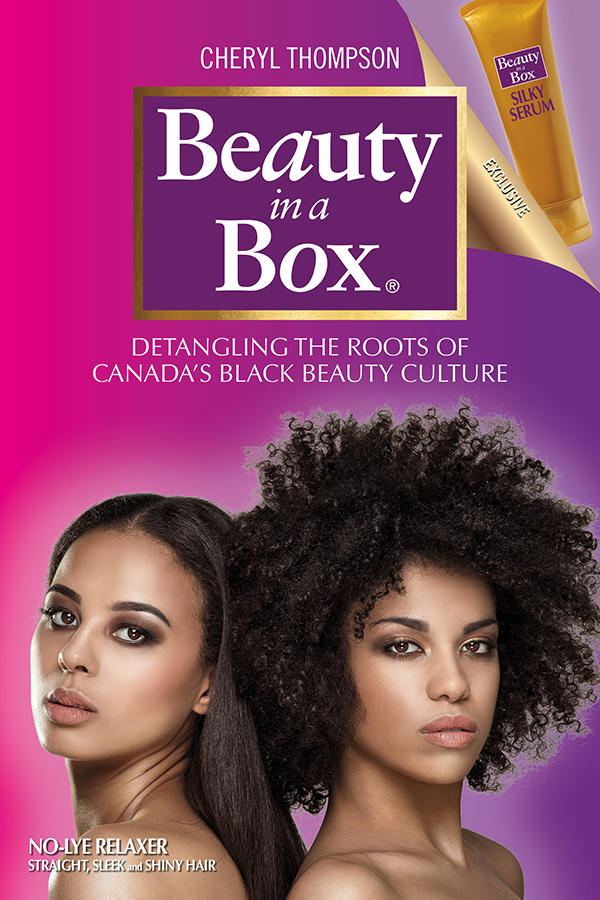
Beauty in a Box: Detangling the Roots of Canada's Black Beauty Culture
by Cheryl Thompson
Wilfrid Laurier Press
April 17, 2019
ISBN-10: 1771123583; ISBN-13: 978-1771123587
One of the first transnational, feminist studies of Canada’s black beauty culture and the role that media, retail, and consumers have played in its development, Beauty in a Box widens our understanding of the politics of black hair.
The book analyzes advertisements and articles from media—newspapers, advertisements, television, and other sources—that focus on black communities in Halifax, Montreal, Toronto, and Calgary. The author explains the role local black community media has played in the promotion of African American–owned beauty products; how the segmentation of beauty culture (i. e., the sale of black beauty products on store shelves labelled “ethnic hair care”) occurred in Canada; and how black beauty culture, which was generally seen as a small niche market before the 1970s, entered Canada’s mainstream by way of department stores, drugstores, and big-box retailers.
Beauty in a Box uses an interdisciplinary framework, engaging with African American history, critical race and cultural theory, consumer culture theory, media studies, diasporic art history, black feminism, visual culture, film studies, and political economy to explore the history of black beauty culture in both Canada and the United States.
Reviews
"Beauty in a Box is a magnificent body of work that centers the hidden history of black Canadian beauty culture in relationship to advertising, retail establishments, and women’s magazines. By including black Canadian women within the visual culture of modernity, Cheryl Thompson rejects the erasure of black female Canadian bodies from representations of beauty and consumerism in Canada. In addition, as a brilliantly pioneering examination of how African American beauty culture shaped black Canada, Thompson fills an important gap in research on global black beauty culture. Beauty in a Box stands as one of the most captivating and well-researched tomes to examine black beauty culture in Canada and transnationally. Read this book!”
- Ingrid Banks, University of California Santa Barbara
Locating ‘Dixie’ in Newspaper Discourse and Theatrical Performance in Toronto, 1880s to 1920s
by Cheryl Thompson
Published by Canadian Review of American Studies
March 8, 2018
Between the 1880s and 1920s, American blackface theatre created “Dixie,” a region and myth that purposefully linked the nation’s frenetic modernity to remembering a “simpler” antebellum past. This article explores how Dixie was reproduced in newspaper discourse and blackface performance at the theatre and local amusements in Toronto.
Entre les années 1880 et 1920, aux États-Unis, le théâtre blackface a donné naissance à « Dixie », une région et un mythe qui associe volontairement la modernité fébrile de la nation au souvenir d’un avant-guerre « plus simple ». Cet article s’intéresse à la façon dont le thème de Dixie a été reproduit dans le discours des journaux et les représentations caricaturales des Noirs dans les théâtres et salles de spectacles de Toronto.
URL: https://utpjournals.press/doi/abs/10.3138/cras.2017.032?journalCode=cras
Uncle Tom’s Cabin Historic Site and Creolization: The Material and Visual Culture of Archival Memory
by Cheryl Thompson
Published by African and Black Diaspora: An International Journal
June 19, 2019
The Uncle Tom’s Cabin Historic Site in Dresden, Ontario is dedicated to the life of Josiah Henson (1796–1883), a Reverend, abolitionist, and ‘conductor’ on the Underground Railroad. The Historic Site is also located on what remains of the Dawn Settlement. Creolization in the context of Trans Atlantic Slavery is thought to have occurred when select elements from the enslaved were mixed, intertwined and reframed with different sets of meanings within sites of enslavement, such that new identities, realities, and sensibilities emerged. Creolization also reflects a relationship between time and space, and the erasure of a past that is replaced by a hybridized present. How is Henson’s creolized (‘real’) life and his fictionalized (‘fake’) life as Harriet Beecher Stowe’s ‘Uncle Tom’ imagined at the Historic Site? In what ways does erasure frame how we read Uncle Tom’s Cabin, as both an archive and a novel?
URL: https://www.tandfonline.com/doi/abs/10.1080/17528631.2019.1611325
Biography
In 2018, Dr. Cheryl Thompson joined the School of Creative Industries as Assistant Professor in the Faculty of Communication & Design at Toronto Metropolitan University. She earned her PhD in Communication Studies from McGill University under the co-supervision of Dr. Will Straw and Dr. Charmaine Nelson. Her first book, Beauty in a Box: Detangling the Roots of Canada’s Black Beauty Culture was published with Wilfrid Laurier Press in 2019. Based on her dissertation research, this book is one of the first transnational, feminist studies of Canada’s black beauty culture and the role that media, retail, and consumers have played in its development. The book analyzes advertisements and articles from media – newspapers, advertisements, television, and other sources – that focus on black communities in Halifax, Montreal, Toronto, and Calgary. Thompson’s book also explains the role local black community media, such The Dawn of Tomorrow, The Clarion, Contrast, and Share magazine have played in the promotion of African American-owned beauty products; how the segmentation of beauty culture (i.e., the sale of black beauty products on store shelves labelled “ethnic hair care”) occurred in Canada; and how black beauty culture, which was generally seen as a small niche market before the 1970s, entered Canada’s mainstream by way of department stores, drugstores, and big-box retailers.
Prior to her position at Ryerson, Thompson was a Banting Postdoctoral Fellow (2016-2018) at the University of Toronto and the University of Toronto Mississauga (UTM) at the Centre for Drama, Theatre and Performance Studies and in the Department of English and Drama. Her project aimed to elucidate the system of meaning in blackface minstrelsy’s theatrical playbills, portraits, photographs, illustrations, and visual ephemera outside the traditional theatre in the spaces and places of nation-building during Canada’s modern period, 1890s to 1950s. This work was an extension of earlier work Thompson did as a PhD Candidate when she was the recipient of the McGill Institute for the Public Life of Arts and Ideas’ (IPLAI) Fred and Betty Price Award and the Max Stern-McCord Museum Fellowship in 2012-2013.
Thompson was also an instructor at the University of Toronto and UTM, teaching courses on Black Canadian Studies, visual culture, consumer culture, celebrity and promotional culture. Her current SSHRC-funded research explores how Toronto’s newspapers editorialized about theatres where blackface minstrelsy was performed between the 1870s and 1930s. By using an interdisciplinary, transhistorical framework, the project will explain the interrelationship between newspapers, touring American minstrelsy, black choral performance, and the theatre in Toronto.
Thompson attended the University of Windsor, earning an Honours B.A. in Criminology. She then worked professionally as an insurance claims adjuster, as a conference producer, and for several years, she was a financial news journalist. Thompson has been a freelance writer since the early 2000s, writing live show reviews, book and film reviews, album reviews, interviews and editorials for such sites as ViveleCanada, Exclaim!, and the former Chart Attack.
In 2015, Thompson won the CJH/ACH’s Graduate Essay Prize. In 2017, Dr. Thompson gave a TEDx Talk at the University of Toronto Scarborough, titled “Why Positive Thinking is Not Enough.” Her academic essays have appeared in Emergent Feminisms: Challenging a Post-Feminist Media Culture; Body Battlegrounds: Transgressions, Tensions, and Transformations; Neoliberalism and the U.S. Media; PUBLIC: Art/Culture/Ideas; African and Black Diaspora: An International Journal; Canadian Review of American Studies; the Journal of Canadian Studies; Canadian Journal of History Annales canadiennes d'histoire (CJH/ACH); and Feminist Media Studies. Thompson was also a contributor to The Ward Uncovered: The Archaeology of Everyday Life (Coach House Books). In addition to her academic writing, Thompson is a frequent contributor to The Conversation, Spacing.ca, and Herizons and has published articles in the Canadian Theatre Review, Rabble.ca, Toronto Star, Halifax Coast, Montreal Gazette, GUTS Magazine, and ByBlacks.com. She grew up in Scarborough, and currently resides in Toronto.
Past Talks
Cheryl Thompson: Beauty in a Box & Canada's Black Beauty Culture
Q&A and book signing to follow. Books available for purchase.
Toronto Reference Library, September 30, 2019
Research Grants
Insight Development Grant
Organization: Social Sciences and Humanities Research CouncilDate: September 1, 2019
Grant amount: 48,072
Details:
“Newspapers, Minstrelsy and Black Performance at the Theatre: Mapping the Spaces of Nation-Building in Toronto, 1870s to 1930s”