

Dr. Sharon Batt
Adjunct Professor of Bioethics and Political Science, Dalhousie University; Independent writer/researcher
Health policy, Pharmacare, Patient advocacy, Pharmaceutical policy, Women's health, Corporate partnerships with civil society organizations, Patient expertise and health products, Breast cancer, Breast cancer drugs, Breast cancer treatment, Short-term rentals, Affordable housing.
Media
How pharma companies try to use funding to sway patient advocate groups
The Chronicle Herald
Taxpayers didn't pay for Christmas party but spending still misguided, says health authority vice-presidentOnline
Following the money between patient groups and Big Pharma
How Billionaires and Big Pharma Battled Canada’s National Drug Plan
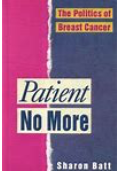
Patient No More: The Politics of Breast Cancer
by Sharon Batt
Gynergy Press (Canada); Scarlet Press (U.K.); Spinifex Press (Australia); Éditions du Remu-Ménage (Québec)
October 1, 1994
ISBN-10: 0921881304; ISBN-13: 978-0921881308
"This book questions assumptions in the world of breast cancer. The author weaves a personal view into a historical and political perspective on the disease and its treatment and develops a feminist argument as to where out future energies might be focused. The book's great strength is that it remains a good read despite its scope.
"As a doctor living with breast cancer, I feel unfortunately well qualified to look at the story so far. The opening account of being diagnosed, with its fear, anger, and disbelief, is chilling. The descriptions of various treatments are some of the clearest I have ever read. What makes them special is the value that the author places on the historical and political context. ...
"I learnt a great deal from this book. As a doctor, I am not used to thinking about the agendas of stakeholders in the cancer market. As a patient, I should be. The commercialisation of cancer, with private ownership of ideas and promotion of profitable drugs, the effect of fraud in research, delay in the peer review process, and the prescriptive views of some cancer charities have all contributed to breast cancer becoming stolen property. The power of groups of women in giving public voice to private grief is well described in the account of the development of Breast Cancer Montreal as a patient advocacy group. The changes needed are political in its broadest sense."
Excerpted from a review by Clare Vaughan, the BMJ, January 28, 1995
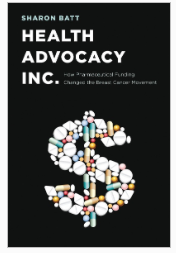
Health Advocacy Inc.: How Pharmaceutical Funding Changed the Breast Cancer Movement
by Sharon Batt
UBC Press
June 15, 2017
ISBN:9780774833844 (hardcover);ISBN:9780774833868 (PDF);ISBN:9780774833875 (ePub); ISBN:9780774833851 (paperback - release date Sept. 15, 2019)
Today, most patient groups in Canada are funded by the pharmaceutical industry, raising an important ethical question: do alliances between patient organizations and corporate sponsors ultimately lead to policies that are counter to the public interest? In this examination of Canada’s breast cancer movement from 1990 to 2010, health activist, scholar, and cancer survivor Sharon Batt investigates the relationship between patient advocacy groups and the pharmaceutical industry – and the hidden implications of pharma funding for health policy.
Health Advocacy, Inc. dissects the alliances between the companies that sell pharmaceuticals and the individuals who use them, drawing links between neoliberalism and corporate financing and the ensuing threat to the public health care system. Batt combines archival analysis, interviews with advocacy and industry representatives, and personal observation to reveal how a reduction in state funding drove patient groups to form partnerships with the private sector. The resulting power imbalance continues to challenge the groups’ ability to put patients’ interests ahead of those of the industry.
Batt’s conclusion is unsettling: a once-vibrant movement that encouraged democratic participation in the development of health policy now eerily echoes the demands of the pharmaceutical industry. This thorough account of the shift from grassroots advocacy to Big Pharma partnership defines the struggles and stakes of activism in public health today.
Biography
Sharon Batt is a freelance writer and an Adjunct Professor of Bioethics and Political Science, at Dalhousie University. Her work combines scholarly research, public education, and social change activism. Batt's book, Health Advocacy Inc. (UBC Press) examines the phenomenon of patient advocacy groups that received funding from pharmaceutical companies funding, how they arose, and their implications for health policy. An article in The Tyee, How Billionaires and Big Pharma Battled Canada's National Drug Plan (April 4, 2019) follows the money behind opposition to a single-payer, publicly-funded drug plan. Both projects move behind-the-scene policy debates into public discussion; both have their roots in her personal experience as a breast cancer patient and advocate, beginning in 1988.
Batt's interest in housing policy related to short-term rentals began in January 2019 when the attached row house next door to her in the historic Hydrostone neigbhourhood of Halifax, which was rebuilt after the 1917 Halifax explosion, was converted to an Airbnb with an owner who does not reside on the premises. She and other neighbours organized as Neighbours Speak Up to draw attention to the downside of the short-term rental boom in Halifax, and the need for regulation to ensure affordable housing and livable neighbourhoods for city residents. Through op-eds, media interviews, presentations to city and provincial politicians, a website (neighboursspeakup.com) and other efforts, the group has grown to provide a voice for concerned citizens throughout the city and in rural areas of the province.